

















































A shoe rack is more than a simple storage product. It is an important home organization solution that helps keep footwear clean, accessible, and neatly arranged. From compact apartment entryways to large retail stores, hotels, dormitories, offices, and commercial projects, the demand for practical and attractive shoe storage continues to grow. For consumers and B2B buyers, understanding different designs, materials, dimensions, and customization options can make it easier to select the right product for a specific application.
Today, buyers can choose from open shelves, vertical racks, stackable organizers, shoe cabinets, benches with shoe storage, wall-mounted solutions, and multifunctional furniture. The best option depends on the available space, the number and type of shoes, interior style, expected load, and intended environment.
For wholesalers, distributors, retailers, and furniture brands, product selection involves additional considerations such as manufacturing consistency, packaging, minimum order quantities, customization, shipping efficiency, and market demand. A clear understanding of shoe rack types, construction materials, and dimensions can help businesses develop a product range that meets different customer requirements.
There are many types of shoe racks available in the market, and each design has a different purpose. Some focus on maximizing storage capacity, while others emphasize compactness, appearance, mobility, or additional functions.
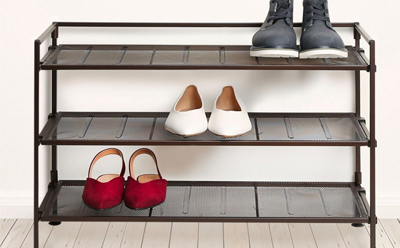
A traditional freestanding rack is one of the most common designs. It normally consists of several horizontal shelves supported by a frame. Depending on the number of tiers, it can accommodate shoes for an individual, couple, or family. Open shelves also make it easy for users to see and access their footwear.
Vertical shoe racks are designed to make better use of limited floor space. Instead of extending widely across the floor, they use height to provide additional storage levels. This makes them useful for narrow hallways, apartments, bedrooms, and entryways where floor area is limited. Industry product guides commonly show standard, tall, modular, and stackable configurations as distinct shoe-storage solutions.
Stackable designs provide another flexible option. Individual units can be placed together vertically or horizontally, depending on the structure. This allows users to increase storage capacity as their needs change.
Shoe cabinets are another popular choice. Unlike open racks, cabinets can hide footwear from view and create a cleaner visual appearance. Some cabinet designs also include doors, drawers, adjustable shelves, or ventilation openings.
For customers looking for greater functionality, a multi function shoe rack can combine several features in one piece of furniture. For example, a shoe rack may include a seating bench, storage compartments, hooks, drawers, umbrella holders, or a small tabletop. Such products are particularly useful in entryways because users can sit down while putting on or removing shoes.
A multifunctional design can also provide greater value for small homes. Instead of purchasing separate furniture for seating and footwear storage, consumers can use one integrated product.
When considering shoe rack types, buyers should therefore look beyond appearance and consider the intended application.

A simple two- or three-tier rack may be sufficient for a small household. A five- or six-tier vertical rack may be more suitable for families with larger footwear collections. A shoe cabinet may be preferred when appearance and dust protection are priorities, while a multifunctional bench-style product can provide both seating and storage.
For commercial buyers, different environments may require different designs. Hotels may need compact storage solutions for guest rooms, retail stores may require display-oriented racks, and dormitories may prioritize lightweight and space-saving designs.
The design should also accommodate different footwear. Sneakers, sandals, flats, high heels, boots, and children's shoes can require different shelf heights and depths. Adjustable shelves can provide greater flexibility for mixed footwear collections.
The shoe rack material has a direct influence on strength, appearance, weight, maintenance, and cost. Common choices include metal, solid wood, engineered wood, bamboo, plastic, and fabric. Each material has different characteristics and is suitable for different market segments.
Metal shoe racks are popular for buyers who prioritize structural strength and durability. Steel frames can provide good load-bearing performance, while powder-coated or other protective finishes can help improve resistance to everyday wear and moisture. Metal designs are particularly suitable for entryways, garages, commercial spaces, dormitories, and modern interiors.
Wood is often selected for its warm appearance and furniture-like design. Solid wood can provide strong structural performance and a premium appearance, while engineered wood can provide a more economical alternative. Wood racks can be designed in traditional, minimalist, rustic, or contemporary styles.
Bamboo can provide a natural appearance while remaining relatively lightweight. It is often used for home storage products where appearance and portability are important.
Plastic shoe racks are generally lightweight and easy to clean. They can be useful for apartments, children's rooms, rental properties, temporary accommodation, and budget-oriented products.
Some manufacturers combine several materials. A product may use a metal frame with wooden shelves, for example, creating a combination of structural strength and a natural appearance. Hybrid construction can also provide opportunities for product differentiation in competitive markets.
When selecting the shoe rack material, buyers should consider more than the initial price. The intended environment, expected load, moisture exposure, appearance, maintenance requirements, and target customer should all be evaluated.
Dimensions are equally important.
The shoe rack dimension determines whether a product can fit comfortably into the intended location while providing enough storage capacity. The three basic measurements are width, depth, and height.
Width determines how many shoes can be placed across each shelf. Depth should be sufficient to support the footwear without creating unnecessary obstruction in a hallway or entryway. Height determines how many tiers can be incorporated into the rack.
Standard shoe racks can vary considerably in size. One industry guide identifies common standard configurations around 80–100 cm wide and 30–40 cm deep, with height varying according to the number of tiers. Custom sizes can be developed for more specialized applications.
When determining the appropriate shoe rack dimension, buyers should measure the installation space first. Consider walls, doors, drawers, walkways, and other nearby furniture. A product that technically fits a room may still be inconvenient if it blocks movement or prevents a door from opening properly.
Shelf spacing should also be considered. Sneakers and flats generally need less vertical space than boots or high-top shoes. If a rack is intended for multiple footwear categories, adjustable shelves can provide additional flexibility.
For commercial projects, standard dimensions may not always meet the customer's requirements. A hotel may need a narrow rack that fits inside a specific room, while a retail store may require a larger display rack. A customized product can be designed around these exact requirements.
This is where shoe rack custom manufacturing becomes valuable. Buyers can request specific width, depth, height, number of tiers, shelf spacing, material, color, finish, wheels, doors, hooks, or additional storage functions.
Customization is particularly useful for wholesalers and brands that want to develop products for a specific market. Instead of competing only on generic designs, a customized rack can be developed around a specific customer group or sales channel.
For businesses purchasing large quantities, shoe rack wholesale sourcing requires a broader evaluation than simply selecting a retail product.
Wholesalers, distributors, retailers, furniture brands, hotels, and commercial buyers should consider product specifications, production capacity, quality consistency, packaging, logistics, customization, and lead times.
The first step is to clearly define the target market. A budget-oriented retailer may prefer lightweight plastic or simple metal racks, while a premium furniture brand may focus on solid wood or hybrid metal-and-wood products.
Businesses also need to consider how the product will be sold. A compact flat-pack shoe rack can be easier to store and transport than a fully assembled product. Efficient packaging can reduce shipping volume and simplify warehouse management.
For buyers searching for a shoe rack for sale in bulk, product specifications should be clearly documented. Important information can include:
Overall width, depth, and height
Number of tiers
Shelf spacing
Maximum recommended load
Material and material thickness
Surface treatment
Color and finish
Assembly method
Packaging dimensions
Product weight
Available customization
Sample availability
A clear specification sheet helps buyers compare products from different suppliers and reduces the risk of receiving products that do not match the intended application.
Customization can also be an important part of B2B procurement. A shoe rack custom project may involve changing only the dimensions, or it may involve a complete redesign.
For example, a buyer may require a 100 cm wide rack for a particular retail display. Another buyer may need a tall, narrow product for apartments with limited floor space. A hotel may request a compact shoe cabinet with a specific finish, while a furniture brand may require its own colors and packaging.
Custom manufacturing can also include functional modifications. A manufacturer may develop a rack with adjustable shelves, removable dividers, wheels, seating, hooks, drawers, doors, or additional storage compartments.
However, customization should begin with clear technical information. Buyers should provide the intended dimensions, number of shoe pairs, shoe categories, installation environment, preferred material, desired appearance, and target market.
The shoe rack dimension should be confirmed before production because even small changes in width, depth, or height can affect material consumption, packaging, storage capacity, and shipping volume.
Material selection should also be finalized early. If the buyer chooses steel, the supplier should confirm tube or wire specifications and surface treatment. For wood products, buyers should specify the desired board or wood type, finish, edge treatment, and color.
A professional manufacturer can then evaluate the proposed design and determine whether adjustments are needed to improve stability, production efficiency, packaging, or cost.
Quality control is another important consideration for shoe rack wholesale buyers. The finished product should be checked for structural stability, surface quality, accurate dimensions, secure connections, smooth edges, and proper assembly.
For metal racks, welding quality and surface coating are particularly important. For wooden racks, buyers should pay attention to board quality, edge finishing, hardware, joints, and surface treatment.
Samples are also useful before mass production. A sample allows buyers to verify the actual shoe rack material, dimensions, appearance, stability, storage capacity, and packaging before committing to a larger order.
Ultimately, choosing the right shoe rack requires a balance between function, design, material, dimensions, and target-market requirements. There is no single solution that works for every customer.
Understanding the different shoe rack types allows buyers to select a suitable design for homes, apartments, offices, hotels, retail stores, and commercial projects. Selecting the right shoe rack material helps determine durability, appearance, maintenance, and cost. Carefully defining the shoe rack dimension ensures that the product fits its intended space while providing sufficient storage.
For B2B customers, shoe rack wholesale sourcing can also provide opportunities to develop customized product lines. Through shoe rack custom manufacturing, businesses can modify dimensions, materials, colors, shelf configurations, and additional functions according to specific market requirements.
Whether customers are looking for a simple storage rack, a multi function shoe rack, a vertical organizer, a shoe cabinet, or a customized commercial solution, the right combination of design and specifications can create a more practical and competitive product.
By evaluating the different types of shoe racks, defining the appropriate dimensions and materials, and working with a capable manufacturing partner, buyers can develop shoe storage products that combine functionality, durability, attractive design, and efficient space utilization. This makes shoe racks not only useful household products but also a flexible category for wholesalers, retailers, distributors, and furniture brands.



Copyright © 2026 Hebei Minmetals Co., Ltd. All Rights Reserved. Sitemap | Privacy Policy | Menu