
















































The trailer industry relies on durable and precisely engineered axle components to ensure stability, safety, and long-term performance. Whether used in agricultural trailers, utility trailers, boat trailers, or commercial semi-trailers, the spindle is one of the most critical parts of the axle assembly. Choosing the right spindle directly affects load capacity, wheel alignment, braking performance, and suspension efficiency.
Among the most popular and widely used spindle types are the trailer axle drop spindle, torsion spindle, trailer wheel spindle, drop axle spindle, trailer spindle with brake flange, and semi trailer axle spindle. Each component serves a specialized function and is designed for specific trailer applications. Understanding their structure, advantages, and applications can help trailer manufacturers, repair shops, and fleet operators make better decisions when selecting axle components.
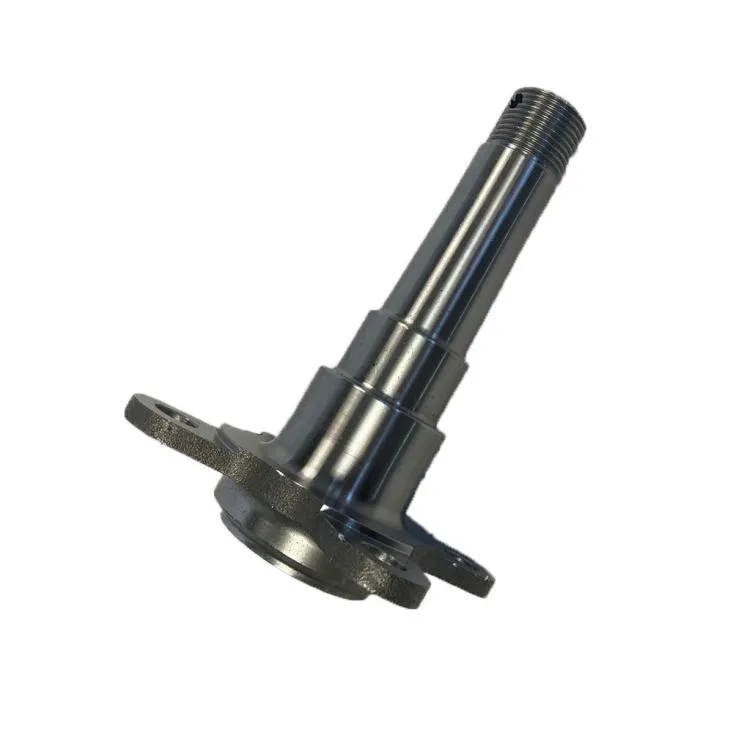
The trailer wheel spindle is the rotating shaft mounted at the end of a trailer axle. It supports the wheel hub and bearings while allowing the wheel to rotate smoothly under heavy loads. Because it carries both radial and axial forces during operation, the spindle must be manufactured from high-strength steel and precisely machined for durability and safety.
A standard trailer wheel spindle typically includes several important sections:
Bearing journals
Seal surfaces
Threaded ends for spindle nuts
Brake mounting areas
Weld connection points
These components work together to provide stable wheel rotation and secure attachment of braking systems. In heavy-duty applications, spindle precision becomes even more important because even minor alignment issues can lead to uneven tire wear, vibration, or bearing failure.
The drop axle spindle is a specialized spindle design that lowers the trailer deck height without sacrificing load capacity. By lowering the center of gravity, trailers gain improved stability and easier loading access. This makes the drop axle spindle highly popular in equipment trailers, car haulers, and low-bed transport systems.
Compared with standard straight axles, a trailer axle drop spindle changes the wheel mounting position relative to the axle tube. This creates additional clearance and allows trailers to maintain a lower profile. Operators often choose this design for transporting heavy machinery or oversized cargo where loading height is a concern.
Another important variation is the trailer spindle with brake flange. This spindle includes a pre-welded flange designed for mounting electric brakes, hydraulic brakes, or disc brake systems. Brake flanges simplify installation and ensure accurate brake alignment. Since trailer braking performance is essential for road safety, many manufacturers prefer using a trailer spindle with brake flange for improved assembly efficiency and reliability.
In commercial transportation industries, the semi trailer axle spindle plays an even more demanding role. Semi-trailers carry significantly heavier loads over long distances and operate under extreme stress conditions. As a result, these spindles are manufactured using premium forged steel and advanced heat treatment processes to maximize strength and fatigue resistance.
One of the biggest advantages of a trailer axle drop spindle is improved trailer handling. Lowering the trailer deck helps reduce sway and improves stability during highway driving. This is especially beneficial for trailers carrying tall or uneven loads.
The lower center of gravity also improves loading convenience. Equipment such as skid steers, forklifts, and compact excavators can be loaded more easily onto trailers equipped with a drop axle spindle. In industries where loading efficiency matters, this design provides significant operational advantages.
A torsion spindle is another highly valuable component used in modern trailer suspension systems. Unlike traditional leaf spring suspensions, torsion axle systems use rubber cords inside the axle tube to absorb road shock and vibration. The torsion spindle is specifically engineered to integrate with this suspension design.
Trailers equipped with a torsion spindle often provide:
Smoother ride quality
Reduced trailer vibration
Lower maintenance requirements
Independent wheel movement
Improved cargo protection
Because torsion suspension systems minimize road shock, they are widely used in boat trailers, recreational vehicle trailers, cargo trailers, and specialty transport equipment. Sensitive cargo such as electronics, medical equipment, or fragile goods benefits greatly from torsion suspension systems.
Another major advantage of the torsion spindle is reduced noise and wear. Traditional spring suspension systems contain multiple moving parts that require lubrication and periodic replacement. Torsion systems have fewer exposed components, which helps reduce maintenance costs and extend service life.
When combined with a trailer spindle with brake flange, torsion systems become even more versatile. Manufacturers can easily integrate braking systems while maintaining compact axle designs. This is particularly important for modern trailers where space optimization and weight reduction are critical engineering goals.
The semi trailer axle spindle also benefits from advanced engineering improvements. Many modern semi-trailer axles now incorporate precision-machined spindle surfaces, corrosion-resistant coatings, and optimized bearing designs. These features improve fuel efficiency, reduce rolling resistance, and enhance overall fleet reliability.
In harsh environments such as mining, construction, and heavy logistics operations, durable spindle construction is essential. A high-quality semi trailer axle spindle can withstand continuous heavy loads, road impacts, and high mileage without compromising safety or performance.
Selecting the correct spindle depends on several factors, including trailer weight, axle type, suspension system, braking requirements, and intended application. Understanding these requirements helps ensure long-term reliability and compliance with transportation safety standards.
When choosing a trailer spindle with brake flange, one of the first considerations is brake compatibility. Different trailer braking systems require specific flange dimensions and mounting patterns. Electric drum brakes, hydraulic drum brakes, and disc brake systems all have unique installation requirements.
Load capacity is another critical factor. A light-duty utility trailer may only require a small trailer wheel spindle, while industrial transport equipment demands heavy-duty forged spindles capable of handling several tons of weight. Using an undersized spindle can lead to premature bearing wear, axle damage, or catastrophic failure.
For trailers requiring lower ride height, the trailer axle drop spindle is often the preferred solution. However, engineers must also consider ground clearance, suspension travel, and tire size to avoid interference issues during operation.
The drop axle spindle is particularly beneficial for trailers transporting vehicles or machinery because it allows easier loading without requiring excessively steep ramps. In addition, lower trailer height often improves aerodynamics and reduces wind resistance during highway travel.
When evaluating a torsion spindle, trailer builders should examine suspension rating, rubber torsion capacity, and spindle dimensions. Matching the spindle correctly with the torsion axle system ensures optimal suspension performance and long-term durability.
Corrosion resistance is also important, especially for marine trailers and outdoor applications. Boat trailers frequently use galvanized or coated trailer wheel spindle assemblies to resist rust caused by water exposure and road salt.
For heavy commercial operations, the semi trailer axle spindle must meet strict industry standards for strength and fatigue resistance. Forged spindles are generally preferred over fabricated alternatives because they offer superior grain structure and higher impact resistance.
Manufacturing precision is another key quality indicator. High-quality spindles undergo CNC machining, heat treatment, hardness testing, and dimensional inspection to ensure consistent performance. Poorly machined spindle surfaces can quickly damage bearings and seals, leading to costly repairs.
As the transportation and logistics industries continue evolving, trailer axle technology is also advancing rapidly. Manufacturers are developing lighter, stronger, and more efficient spindle designs to meet increasing demands for fuel efficiency, payload optimization, and operational reliability.
Whether used in agricultural equipment, utility trailers, marine trailers, or heavy-duty freight transport, components such as the trailer axle drop spindle, torsion spindle, trailer wheel spindle, drop axle spindle, trailer spindle with brake flange, and semi trailer axle spindle remain essential for safe and efficient trailer performance. Investing in high-quality spindle systems not only improves trailer durability but also enhances road safety, reduces maintenance costs, and increases long-term operational efficiency.



Copyright © 2026 Hebei Minmetals Co., Ltd. All Rights Reserved. Sitemap | Privacy Policy | Top Blog丨Menu