














































































Trailer couplers are essential components that connect a trailer to a towing vehicle. Although relatively small compared with the trailer frame, a coupler plays a critical role in establishing a secure connection between the trailer and the hitch ball. Choosing the correct coupler requires careful consideration of trailer design, tongue configuration, towing capacity, hitch-ball size, installation method, and operating conditions.
Different trailer designs require different coupling solutions. Common options include round tongue trailer coupler, straight tongue coupler, adjustable designs, and heavy-duty models. Understanding the differences between these products can help trailer manufacturers, distributors, repair shops, and end users select a suitable component for their applications.
A quality coupler should provide reliable mechanical engagement, appropriate load capacity, corrosion resistance, and convenient operation. It should also be correctly matched with the trailer frame and towing system. Before installation or replacement, users should always verify the manufacturer's specifications and applicable safety requirements.

The term trailer couplers covers a broad range of mechanical devices designed to connect trailers to towing vehicles. While their basic function is similar, their construction and mounting methods can vary considerably depending on the trailer tongue.
One common design is the round tongue trailer coupler. As its name suggests, this type is designed for trailers that use a round tube or compatible cylindrical tongue. The coupler fits over or attaches to the trailer tongue and provides the connection point for the towing vehicle. Round-tongue designs are commonly found on utility trailers, small cargo trailers, landscaping trailers, and other applications where tubular trailer frames are used.
Another common option is the straight tongue coupler. This design is intended for trailers with a straight or rectangular tongue configuration. It can provide a straightforward connection between the trailer frame and the towing system.
A straight trailer coupler may be available in different mounting styles, dimensions, and load ratings. Some models are designed to slide over the trailer tongue, while others can be welded or otherwise permanently attached according to the manufacturer's installation instructions.
When comparing trailer tongue coupler types, buyers should first identify the physical configuration of the trailer tongue. A coupler designed for a round tube may not be suitable for a rectangular tongue, and dimensional compatibility is essential for proper installation.
The coupler's connection mechanism is another consideration. Some couplers use a latch mechanism that locks around the hitch ball, while other designs incorporate additional safety features to help maintain engagement. Users should understand the operating procedure of the specific model before towing.
Material is also important. Steel is widely used for trailer couplers because it can provide the structural strength required for towing applications. Surface treatments such as zinc plating, galvanizing, or protective coatings may be used to improve resistance to moisture and corrosion.
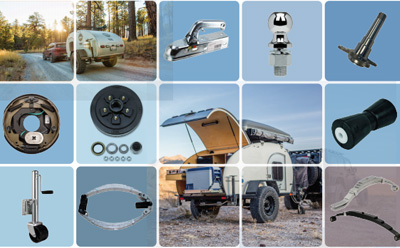
The coupler should also be considered as part of the complete trailer system rather than as an isolated component. The trailer frame, tongue, hitch ball, safety chains, tires, suspension, brakes, and other components must all be compatible with the intended towing conditions.
An adjustable trailer coupler provides additional flexibility when trailer manufacturers or users need to accommodate different tongue positions or mounting configurations. Depending on the design, adjustable systems may allow the coupler position to be changed along a compatible mounting structure.
This can be useful for trailers that require flexibility during assembly or for applications where the final coupler position needs to be fine-tuned. Adjustable designs can also simplify certain trailer-building configurations because the manufacturer does not necessarily need to determine the final coupler position before completing every part of the frame.
However, adjustment must always be performed according to the manufacturer's instructions. Fasteners should be correctly sized and tightened, and the finished assembly must remain within the specified load rating. The adjustable feature should never be used to exceed the rated towing capacity of the coupler or trailer.
For demanding applications, a heavy duty trailer coupler may be appropriate. Heavy-duty couplers are designed for trailers carrying larger loads or operating under more demanding conditions. They may feature thicker steel sections, reinforced structures, larger mounting areas, and higher rated capacities than lightweight models.
Heavy-duty couplers can be used in applications such as construction trailers, equipment trailers, agricultural trailers, commercial utility trailers, and other platforms designed to transport substantial loads.
When selecting a heavy-duty model, users should pay close attention to the complete capacity specification rather than assuming that a larger-looking coupler automatically provides greater towing capability. The coupler rating needs to be compatible with the trailer's gross weight requirements and the towing system.
For manufacturers and distributors, offering several coupler configurations can help meet different customer requirements. A product range may include round-tongue models, straight-tongue models, adjustable couplers, and heavy-duty versions with different dimensions and load capacities.
The finish can also influence product selection. Trailers frequently operate outdoors and may encounter rain, road spray, mud, dust, and changing temperatures. A suitable protective finish can help reduce surface corrosion and maintain the appearance of the coupler over time.
For applications involving frequent loading and unloading, ease of operation is another useful consideration. A coupler that is easy to open, position, and secure can make trailer connection more convenient. Nevertheless, convenience should not replace proper inspection and secure locking procedures.
Selecting the appropriate coupler begins with identifying the trailer's tongue dimensions and structure. Measure the tongue carefully and compare its shape and dimensions with the coupler manufacturer's specifications.
For a round tubular tongue, a round tongue trailer coupler may be the appropriate configuration. For a straight or rectangular tongue, a straight tongue coupler can provide a better structural match. The internal and external dimensions should be checked carefully to ensure the coupler is compatible with the trailer frame.
The required towing capacity is another critical factor. Users should determine the expected loaded trailer weight and select a coupler with an appropriate rated capacity. It is also important to verify compatibility with the hitch ball, because the coupler and ball must be designed to work together.
Mounting method should be considered as well. Depending on the product, a coupler may be designed for welding, bolting, or another approved installation method. Installation should follow the manufacturer's specifications. Improper modification, welding, or drilling can weaken the component and compromise the trailer structure.
Before each towing operation, users should inspect the coupler and its locking mechanism. Look for visible cracks, deformation, excessive wear, corrosion, damaged hardware, or other signs of deterioration. The latch should operate correctly and provide secure engagement with the compatible hitch ball.
Safety chains should also be connected correctly as part of the overall trailer setup. A coupler is only one component of the towing system, so inspection should cover the entire connection between the towing vehicle and trailer.
Lubrication may be required for certain moving components, depending on the manufacturer's maintenance instructions. Regular cleaning can also help remove dirt, road salt, and other contaminants that may contribute to corrosion or interfere with the locking mechanism.
For businesses purchasing trailer couplers in bulk, product specifications should be reviewed before placing an order. Important factors include material, dimensions, mounting configuration, rated capacity, hitch-ball compatibility, surface treatment, testing requirements, packaging, and customization options.
Manufacturers serving OEM customers may also provide customized coupler dimensions, mounting holes, finishes, labels, and packaging. This can be useful for trailer brands that need components matched to specific frame designs.
Ultimately, understanding different trailer tongue coupler types makes it easier to select a component that matches the trailer's structure and intended application. A straight trailer coupler can be suitable for compatible straight tongues, while a round tongue trailer coupler is designed for appropriate round-tube configurations. An adjustable trailer coupler provides greater installation flexibility, while a heavy duty trailer coupler is intended for applications requiring higher structural capacity.
By carefully checking dimensions, load ratings, hitch compatibility, mounting methods, and maintenance requirements, trailer manufacturers and users can select an appropriate coupler for their specific application. Proper installation and routine inspection are equally important for maintaining a secure and reliable trailer connection over the service life of the equipment.



Copyright © 2026 Hebei Minmetals Co., Ltd. All Rights Reserved. Sitemap | Privacy Policy | Menu